Like any vintage electronics collector, I love retrobrighting and restoration videos. They are a huge part of what got me into it in the first place. Seeing a device that would normally be thrown into the trash restored to its former glory is extremely satisfying, and a high that I've been chasing for a while. Here are a few of my favorites:
These people are much better than I am at restorations and creating videos, but they have inspired me to be a part of this subculture that tries to keep old electronics working for people to appreciate.
Canon P101-D.
That being said, I have utterly failed to retrobright or restore the Canon P101-D that I recently purchased at Goodwill for $10. When I first laid my eyes on it, I was thrilled to see a device with such a bold orange color. This was the kind of desktop calculator that would turn heads at any cubicle farm. I was going to make other calculator collectors salivate over my unique find. I needed this after learning that a fellow collector owns a Curta.
Proof that I talked to a person.
This was followed up by an image of what the calculator is supposed to look like:
Source: not me.
Needless to say, I was devastated. But I also saw an opportunity to attempt my first retrobright. The video attached to this review shows my process, and I'm trying to get more views, so if you're interested in seeing how that went, check it out. To quickly summarize, it didn't work at all.
The Canon P101-D is a fantastic desktop calculator regardless. It's quite large but doesn't feel like it's wasting space. The numeral and operation buttons all press like mechanical keys with instantaneous responses. The exception is the "paper feed" button, but not at all in a bad way. It has its own sort of deliberate feel when pressed.
Very sturdy and reliable internal components.
When using the printer, every calculation is loud and mechanical, and it's awesome. It feels like a large cash register when this thing really gets going. It's hard to explain, but while loud and mechanical might seem annoying, it feels more like a reminder that this device will probably continue working forever.
And of course all of this leads up to the absolutely gorgeous green LED display. Even with a cracked display cover (my fault), numbers have never looked better. This is simply a beautiful, solid calculator that I will proudly keep on display.
I'm tempted to leave it in the sun for a bit to even out the discoloration, but there's a possibility I'll be revisiting this device in the future with another retrobrighting attempt.
I have contacted Canon customer support to try to find the release year for this model, but they were unable to provide me with an answer. I've searched around for the answer and have found nothing so far. If you have any information about the release year, please let me know so that I can update this review.
Cracked screen (my fault). Still looks great though.
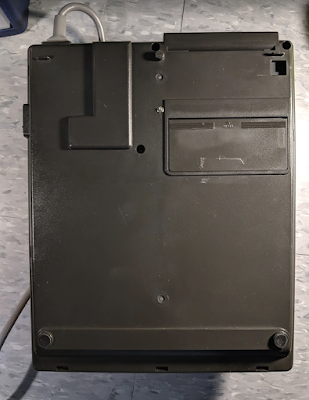
The bottom of the calculator, if you're into that sort of thing.
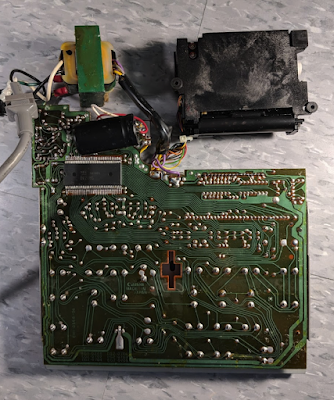
Bottom of internal components. Excellent materials all around.
Inside view with keys removed.
Every key is made of a nice thick plastic.
View of the LED screen without protective (and broken) cover.
Taking a week off to focus on non-calculator aspects of my life has been beneficial. I missed reviewing my calculators though, so I'm very happy to be back to tell the world what I think about them.
To make up for the lack of reviews, I decided to start this brand new week off with something truly special...
Fans of calculator reviews, this day marks the end of an era. I've been reviewing calculators for a while now, and at long last it's time to bring about the conclusion. I hope this doesn't disappoint everyone, but I understand if it does. Today, I am reviewing the third and final Dollar Tree $1 Jot Calculator.
My hopes were not high for this device, especially after the Jot Scientific Calculator and the Jot Pocket Calculator. Long-time followers of these reviews will also notice that today's calculator closely resembles the Big Display 8-Digits Electronic Calculator. I'd been dreading opening the packaging because I knew this calculator was going to suck. It's time I move on with my life and be done with the Jot line.
This calculator sucks. It's exactly the same as the Big Display, except it doesn't pretend to be solar powered. The internals are identical. The only difference with this one is the color scheme. I like the black and white look, but it's wasted on this garbage.
I don't recommend this calculator nor any other device in the Jot line. I'm sorry this is such a short review.
It's Friday again already so that means another Facebook review. I've still got quite a few of these so this tradition will last a while. Unlike the previous remakes of Facebook reviews, this one had enough thought put into it to simply be copied to this site. The first few Facebook reviews had very little content, but later ones were much better. So I'm proud to say I put minimal effort into this Facebook Friday Calculator Review.
Sharp Compet VX-2126A.
Every morning* since I've started on this quest to review
all of my calculators, I get out of bed, open the blinds for my pet to look
outside, pour myself an iced coffee, and then return to the bedroom to select a
calculator from the shelf. I look forward to this, even when I don't
particularly care for the calculator of the day. But today is special. Today, I
share with you the...
Sharp Compet VX-2126A. This thing has a MASSIVE 12-digit
LCD screen, capable of handling any number between 0 and one less than a
trillion with ease. Worried you need to work with numbers bigger than that?
Well stop worrying, because this beast also lets you use exponents.
The Compet VX-2126A is solidly constructed with a
combination of metal and plastic. Even a firm grip on any two points (including
the screen) doesn't feel like it's going to hurt this thing. It features a
hinged stand to increase the viewing angle on a desk that would also take a lot
of pressure to break off. As far as I can tell, this was constructed in Japan
ca 1983.
But none of that is what makes this calculator special. I
told that story at the beginning because, since I've owned this calculator, every
morning I see this beast chugging along. You see, this calculator *never* turns
off as long as it has even the tiniest amount of light. This is by far the most
reliable calculator I have ever owned.
The Compet VX-2126A uses no batteries. It's beautiful,
sturdy, and has more functionality than I would expect from a purely solar
calculator. I found it at Goodwill for like $1.99.
Disassembled, front and back.
* I no longer write these the morning they are posted, so this routine no longer applies to my calculator reviews. I considered removing this no-longer-true statement, but it would affect the flow and themes of the review negatively. It would require considerably more effort to restructure the review than to explain myself here. Thank you for your understanding.
Fans of calculator reviews, I feel bad for discussing two terrible calculators in a row. I try to post a variety of devices throughout the week to keep things from getting boring, and I failed to do that. So to make up for that, I picked a calculator today that I intended to review later on. Today's calculator is a good one.
Casio HR-150LC
The Casio 2-Color Print HR-150LC is the first printing calculator that I added to my collection. I tended to avoid these for some reason, but due to Casio's nearly impeccable reputation for making solid devices, I decided to check it out. I am so glad I did, because the HR-150LC is fantastic.
Unlike the "Big Display" reviewed yesterday, the HR-150LC doesn't try to brag about anything, yet has every right to do so. The display on this is actually huge, and is viewable from almost any angle. Every digit contrasts clearly with the LCD.
Each button feels solid and clicky, so every operation you perform with it is going to feel great, especially if you're using the print feature. It's loud without being obnoxious. The printing mechanism has a weighty feel to it that might cause a lighter calculator to violently shake, but this device is heavy and strong enough to handle it just fine. Even the switches to turn the calculator on or change the floating point are a pleasure to use. It's all very responsive and will make you feel like you can kick math's ass today.
Small but powerful: the printing mechanism.
Whether you're printing calculations or not, the HR-150LC is an absolute pleasure to use. The muted color scheme of the buttons doesn't emphasize contrast yet still manages to look great. Casio is a company that clearly strives to make the best calculator it can and I've always felt like I've got what I paid for with their devices.
It might seem like I'm biased toward Casio, but that's honestly not the case. It's HP calculators that I tend to get overly excited about*. Yet since I've been collecting, Casio has impressed me every single time.
The HR-150LC can run on four AA batteries or the A/C adapter that came with it. I found this one at a local thrift shop for $6. Casio no longer produces this device, as it has been replaced by the HR-150TMPlus. Unfortunately I couldn't find release years for either device, so my best guess is the HR-150LC came out some time in the 1990s.
Back, with battery cover and paper feed.
Back, battery cover removed.
Internal components. Nice and roomy.
Non-essential components removed.
* Before you point out that you can't end a sentence with a preposition, please do some actual research on the English language because you totally can.
It's midterm election day! This isn't a political blog, but I want to capitalize on events with these reviews, so I spent some time choosing my most American calculator. Naturally, I selected the Big Display 8-Digits Electronic Calculator with American Flag, which comes to us from China.
BD8-DEC: POS
Like the most American things, the Big Display 8-Digits Electronic Calculator (BD8-DEC from here on out) is needlessly large. It's also cheap, deceptive, and easily broken. While on the surface it functions just fine, this comes at the cost of literally every other facet of this calculator.
To start, this thing is called the Big Display, but the display is the most standard size part of the calculator. There's a frame around the LCD that looks like it might have been a placeholder for a much larger display. It can be tilted for varying viewing angles, but there's nothing holding the tilt you want, so this feature is completely pointless. Also, the LCD doesn't have enough contrast to reliably show digits at many different angles.
Then there are the buttons. They feel like they could just fall out of the device if you turned it upside down. Pressing them at speed causes the entire calculator to rattle loudly, and like yesterday's calculator, there's a slight delay between press and appearance on the screen.
Gripping both sides of the calculator, it feels like a child could snap this thing in half with little effort. I would not feel safe leaving this on a desk with books or anything heavier than a pencil. I disassembled the calculator and found more inferior materials used for the interior.
Worthless plastic inside a worthless calculator.
And that's when my blood began to boil. I've addressed this in the Facebook reviews, but not here yet. I was recently made aware of fake solar cells in calculators, so I've been keeping an eye out for them. Today I found one. This is not a solar-powered calculator at all. It runs on a single LR1130 battery* hidden behind eight micro screws. The designers and manufacturers of this calculator had no intention of making a device that would last.
Removing the battery revealed how cheap even the metal holding it in place is. Much of this metal has been corroded. Every expense was spared to produce this awful device. The BD8-DEC can be found at pretty much any thrift store, and there's no wonder why. No one wants this crappy calculator. I don't even want it.
I resisted buying one of these for the longest time because I wanted to collect quality calculators. The only reason I finally picked one up was because I started writing these reviews, and wanted a large diversity of devices. I found it at Goodwill for $1.50, and I hate that it's part of my collection now. The creators of this calculator should be ashamed of themselves.
0/10 even though I don't rate calculators on a numerical scale.
Don't forget to vote today!
Closer view of fake solar cell.
Components inside look and feel cheap.
Complete view of the interior.
* I tried to test yesterday's calculator using this LR1130, but it doesn't have enough power to run it.
The Calculator Review series began on Facebook, so there have been more reviews than just those posted here. Since the first few weren't particularly in-depth, I thought it'd be a good idea to rewrite them here. So, for the next several weeks, every Friday will be a Facebook review updated for the modern era.
The Aurora DC-10
The Aurora DC-10 was not only the first calculator I ever reviewed, but the first calculator I ever collected. Yes, I had devices before it, but I didn't think much of them. The DC-10 changed everything for me.
Even from a distance, the DC-10 is magnificent. Its bright brushed aluminum face place sits in stark contrast to the finished black plastic exterior. The 10 digit screen is wide and bold, and every button sticks out prominently. This is the kind of device that has no intention of being mistaken for anything else.
Picking it up, it's surprisingly heavy, even without the batteries. Oh yeah, this badass runs on two D batteries. It's absurd. There's a minor feeling of crunchiness every time you squeeze it, but that's only because this thing has so much room on the inside. Having taken it apart for a deep cleaning, this was very appreciated. The Duke is a device you can put on your desk without worrying about losing it under piles of paper.
All this praise, and we haven't even got to the functionality yet.
Switching it on, the fluorescent display is very bright and easy to see from a comfortable angle while sitting. Every button feels as good as it looks, and feedback on the screen is instantaneous. This is the closest a calculator of mine has felt to being a mechanical keyboard. It's glorious.
Basically the only place you can find any information about
this calculator
How the Aurora DC-10 didn't become the standard for desktop calculators, I will never understand. In fact, there's hardly any information about it available anywhere. The company's website doesn't even mention it, and other online calculator museums just have a few photos. You can find these on Ebay for around $20, so I know there are more out in the wild.
My best guess is it was released in the late 70s or early 80s. I base that only on the fact that it runs on D batteries, which isn't common at all. If you search online for Aurora DC-10, you're going to mostly find information about an airplane, and as far as I can tell, this calculator has absolutely nothing to do with that. What I do know is that it was made in Taiwan because that's what it says on the back label.
While it's not the most valuable calculator I own, it's the most precious to me. No other calculator in my collection fills me with as much pride and joy as the DC-10. I cannot recommend this calculator enough if you're looking for a solid desktop with basic algebraic functionality.
I found this beautiful representation of vintage electronics at Goodwill for $2.99, and my life hasn't been the same since.
An easily disassembled calculator is always appreciated.
Amazing that such a small board can handle so many calculations
A fan has requested that I post the original Facebook review as well, so I will do this for each calculator: